A contractor in Billings once told us he’d spent thousands on flyers and radio spots over the years, yet most new customers still found him through a quick Google search after a friend mentioned his name. That single detail says a lot. People search before they call, click before they visit, and read reviews before they trust a business enough to spend money with them. Search engine optimization is what makes sure a business actually shows up when that search happens.
At Rank Fam, we work with businesses across Billings, Montana that want steady, long-term traffic instead of a short burst from a one-time ad campaign. This piece breaks down what search engine optimization actually involves, why it pays off for almost any type of business in Billings, and where to start if a business hasn’t touched its website’s search performance in years.
What Is Search Engine Optimization?
Search engine optimization is the practice of shaping a website so Google and other search engines understand it, trust it, and rank it well for the terms customers actually search. That work breaks down into three main pieces: content and on-page structure, technical health behind the scenes, and off-page signals like backlinks and mentions from other trusted sites.
Ask yourself this: how many businesses in Billings have a great product or service but a website that barely shows up past page two of Google? Search engine optimization closes that gap between quality and visibility.
Why the Investment Pays Off
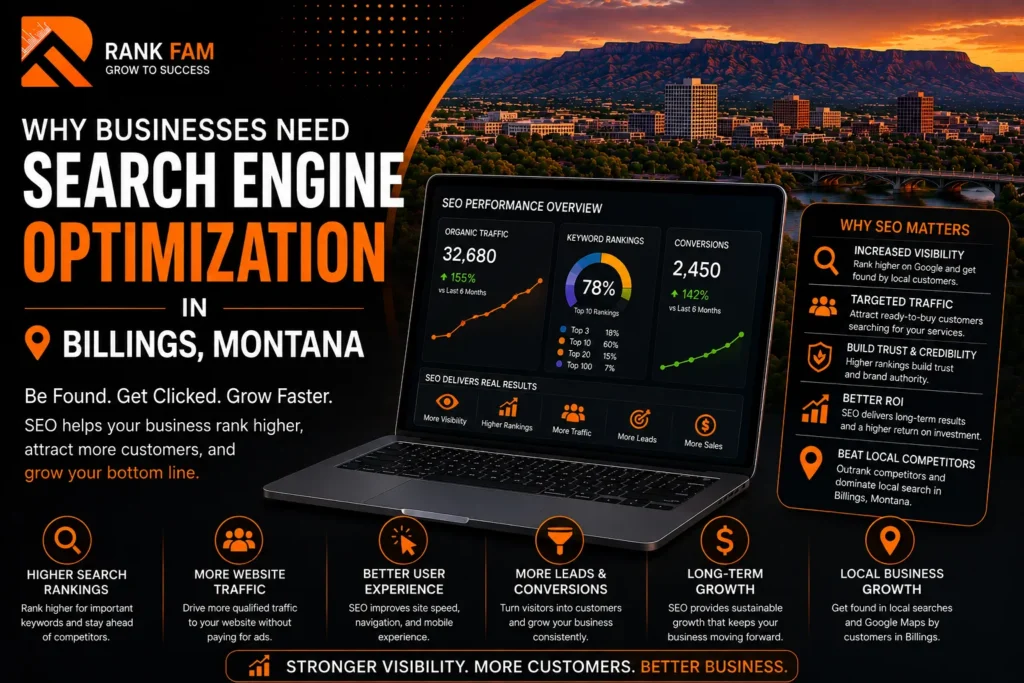
The numbers make a strong case for treating search engine optimization as a priority rather than an afterthought. Industry data from HubSpot shows that leads generated through organic search close at roughly 14.6%, compared with just 1.7% for outbound methods like cold calls. Organic search also drives an estimated 53% of all website traffic, according to research from BrightEdge, which makes it the single largest source of traffic most businesses have access to.
That intent gap explains the difference. A customer who typed a search into Google is already looking for a solution, while someone who picks up a cold call usually isn’t thinking about the product at all yet. A Billings business that shows up for the right search terms meets customers exactly when they’re ready to buy, rather than interrupting them before they’re interested.
The Three Pillars of Search Engine Optimization
Search engine optimization isn’t one single task. It’s a mix of work that touches different parts of a website and its presence across the internet. Here’s how the three main pillars break down:
| Pillar | What It Covers | Why It Matters |
| On-page | Content, keywords, headings, internal links | Tells search engines what each page is about |
| Technical | Site speed, mobile design, crawlability | Makes sure search engines can access and read the site |
| Off-page | Backlinks, mentions, brand reputation | Builds trust and authority in Google’s eyes |
A business that only focuses on one pillar tends to hit a ceiling. Strong content on a slow, hard-to-crawl site rarely ranks well, and a fast, well-built site with thin content struggles just as much.
Building Content That Actually Ranks
Content sits at the center of most search engine optimization work, but not every piece of content pulls its weight. A blog post stuffed with generic advice rarely competes with a page written around the specific questions a Billings customer types into Google before making a decision.
Good content answers a real question, uses the kind of language a customer would actually search for, and gives a clear next step once the reader finishes. A roofing company writing about “signs your roof needs repair before winter” speaks directly to a Montana audience dealing with heavy snow loads, in a way that generic national content never could.
Building Authority Through Links and Mentions
Backlinks, meaning links from other websites pointing back to yours, remain one of the strongest trust signals search engines use. A mention from a respected local news site, a partnership announcement, or a guest post on an industry blog all send a signal that a business is established and worth trusting.
For a Billings business, local partnerships often provide the easiest path to this kind of authority. A sponsorship with a community event, a feature in a local business directory, or a joint promotion with a neighboring business can all produce a link worth more to search rankings than a dozen low-quality directory submissions.
Common Mistakes That Hold Businesses Back
A few patterns show up again and again when we review a new client’s site:
- Publishing content once and never updating it again
- Ignoring site speed and mobile performance
- Targeting broad, competitive keywords instead of specific, winnable ones
- Skipping basic technical fixes like broken links and missing metadata
- Treating search engine optimization as a one-time project instead of ongoing work
Conclusion
Search engine optimization gives a Billings business a way to earn steady traffic that keeps working long after a single ad campaign ends. Strong content, a technically sound website, and a handful of trustworthy backlinks all work together to build the kind of visibility that compounds over time instead of disappearing the moment a budget runs dry. Businesses that treat this as ongoing work, rather than a one-time fix, tend to see the strongest and most lasting results. Getting started now puts a business ahead of competitors still relying on outdated marketing alone.
Frequently Asked Questions
How long does it take to see results?
Most businesses start seeing measurable movement within three to six months, though full results often take closer to a year to settle in fully. Newer websites or highly competitive industries can take longer, while established sites with strong existing content sometimes see faster gains. Consistency matters more than speed in almost every case.
Is this worth it for a small local business, or only big companies?
Small local businesses often see a stronger return than large national companies, since local competition for search terms tends to be lighter in a market like Billings. A well-optimized local business page or service page can outrank bigger competitors that never bothered to build proper content around specific local terms.
What’s the difference between paid ads and organic search work?
Paid ads bring in traffic immediately but stop the moment the budget runs out, while organic rankings keep bringing in visitors without ongoing ad spend once they’re established. Many businesses run both together, using ads for a short-term push while organic work builds toward results that last well beyond any single campaign.
How much content does a website need to rank well?
There’s no fixed number, but a steady publishing schedule tends to outperform a one-time content dump, even if the total word count ends up similar. Search engines favor sites that show ongoing activity and relevance over ones that published a batch of pages once and never touched them again.
Can a business handle this work on its own, or does it need outside help?
A business owner with time and patience can handle basic on-page fixes and content writing, but technical issues and link-building strategy often benefit from outside expertise. Many businesses start with the basics themselves and bring in outside help once they want to move faster or tackle more technical parts of the work.