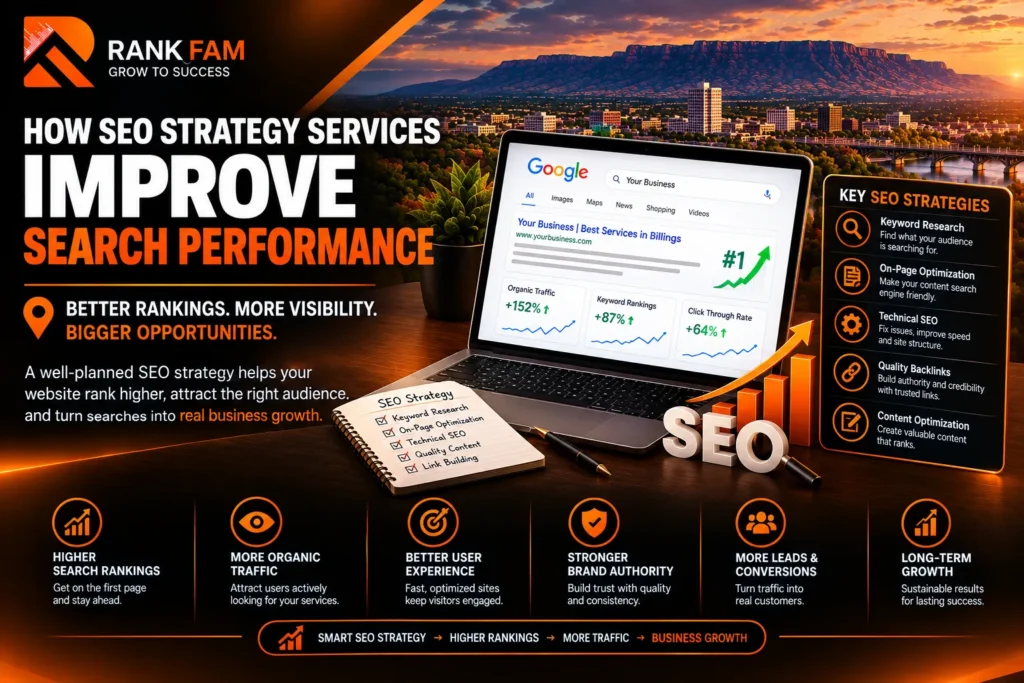
Have you ever published a page, waited weeks, and watched almost nothing happen? That’s one of the most common frustrations we hear about. Most of the time, the content itself isn’t the problem. The problem is that it wasn’t part of any real plan. That gap is exactly what SEO Strategy Services are built to close.
Rank Fam works with businesses that have tried SEO on their own and hit a wall. In this piece, we’ll walk through how a real strategy changes search performance, what separates scattered effort from coordinated work, and what specific pieces tend to move the needle fastest.
Why Random Effort Rarely Moves Rankings
A lot of businesses treat SEO like a checklist. Write a blog post here, fix a meta title there, build a backlink when time allows. None of that is wrong exactly, but without a plan connecting these actions, results stay flat. Search engines reward consistency and relevance built up over time, not scattered bursts of activity.
Google’s own search quality documentation places heavy weight on demonstrating expertise, experience, authority, and trust through a site’s overall content, not just individual pages. That’s a strong signal that isolated tactics, done without a bigger structure behind them, rarely produce the kind of sustained ranking movement most businesses are actually after. Coordinated SEO Strategy Services address this by connecting technical work, content, and links under one plan instead of treating each as separate.
What a Real SEO Strategy Actually Includes
Strategy sounds abstract until you break it into pieces. Here’s what typically goes into a working plan.
| Strategy Component | What It Involves | Why It Improves Performance |
| Keyword mapping | Assigning specific keywords to specific pages | Prevents pages from competing against each other |
| Content calendar | Planned topics based on search demand | Builds topical relevance steadily over time |
| Technical health checks | Site speed, mobile usability, indexing issues | Removes barriers that block ranking potential |
| Competitor gap analysis | Finding topics competitors rank for that you don’t | Uncovers opportunities others have missed |
| Link building plan | Targeted outreach for relevant, quality links | Builds authority signals search engines trust |
| Reporting cadence | Regular tracking of rankings and traffic | Shows what’s working and where to adjust |
Notice how each piece feeds into the next. Keyword mapping shapes the content calendar. Competitor gap analysis often reveals technical issues competitors have already solved. None of these work particularly well in isolation, which is the core argument for treating SEO Strategy Services as one connected system rather than a set of separate tasks.
Keyword Mapping Solves a Problem Most Sites Don’t Know They Have
Here’s a question worth asking. Do you know which page on your site is supposed to rank for your most important keyword? A lot of business owners can’t answer that clearly, and it’s usually because multiple pages accidentally target the same term. When that happens, pages compete against each other instead of working together, and neither one ranks as well as it could.
We reviewed a client’s site last year and found four separate blog posts all loosely targeting the same core phrase. None of them ranked in the top twenty. Once we consolidated the strongest content into one page and redirected the others, that single page moved into the top ten within two months. Same content overall, just organized with a plan behind it.
Why Competitor Gap Analysis Matters So Much
Most businesses only look at their own site when planning content. That leaves a lot on the table. Checking what competitors rank for, and specifically what they rank for that you don’t cover at all, often uncovers opportunities that are easier to win than starting from scratch.
A study from Ahrefs on ranking factors found that pages covering topics comprehensively, addressing related subtopics a searcher might also want answered, tend to rank higher than narrower pages targeting just one keyword phrase. That points directly to why gap analysis works. Filling in the topics competitors already cover, plus the ones they’ve missed, builds a stronger overall footprint than guessing at content ideas without checking what’s already working for others in your space.
Technical Health: The Part That Quietly Undermines Everything Else
Great content on a slow, poorly structured site still struggles to rank. Search engines factor in page speed, mobile usability, and how easily their crawlers can access and understand a site’s structure. A single technical issue, like broken internal links or duplicate pages competing against each other, can hold back rankings even when the content itself is strong.
Regular technical health checks catch these problems before they cause lasting damage. This part of SEO Strategy Services often gets overlooked because it’s less visible than writing new content, but skipping it tends to cap how far the rest of the strategy can actually go.
Link Building With a Plan Behind It
Random link building rarely produces strong results, and in some cases, low-quality links can actually hurt a site’s standing. A targeted approach, focused on relevant sites within your industry or niche, builds trust signals search engines take seriously. This means outreach based on genuine relevance rather than volume for its own sake.
A strategy-driven approach to link building also ties back into content. Pages worth linking to tend to be the ones that cover a topic thoroughly, which loops back to the content calendar and competitor gap analysis mentioned earlier. Everything connects, which is the whole point of treating these as one system.
Measuring What Actually Works
None of this matters without tracking results. Regular reporting shows which pages are climbing, which keywords are gaining traction, and where traffic is actually converting into leads or sales. Without this feedback loop, it’s easy to keep doing work that isn’t producing results, simply because there’s no clear signal telling you to change course.
Rank Fam builds reporting into every stage of the process rather than treating it as an afterthought at the end of a project. Catching a stalled keyword early means adjusting the approach before months of effort go into something that isn’t working.
Conclusion
Search performance improves when individual actions connect to a bigger plan instead of happening in isolation. SEO Strategy Services tie keyword mapping, content planning, technical health, and link building together so each piece supports the others rather than working against them. Competitor gap analysis often reveals faster wins than starting content from scratch, while regular reporting keeps the whole approach honest about what’s actually working. Businesses that treat SEO as one coordinated system, rather than a list of separate tasks, tend to see steadier gains that hold up over time. Rank Fam builds that kind of coordinated plan around each client’s specific goals and search landscape.
FAQs
How is a real SEO strategy different from just posting content regularly?
Posting content without a plan often means competing against your own pages or missing topics your audience actually searches for. A real strategy maps keywords to specific pages, checks what competitors already rank for, and builds content around actual gaps. This coordinated approach tends to produce steadier results than random publishing.
How long before SEO Strategy Services show measurable results?
Early technical fixes can show improvement within a month or two, but meaningful ranking gains for competitive keywords usually take three to six months. The exact timeline depends on your industry, current site health, and how much existing content needs adjustment. Consistent work over time tends to outperform short bursts of activity followed by long pauses.
What happens if my site already has decent content but poor rankings?
This is common, and it usually points to technical issues or keyword cannibalization rather than a content quality problem. Multiple pages targeting the same keyword, slow load times, or crawl errors can all hold back otherwise strong content. A technical audit combined with keyword mapping often identifies exactly where the disconnect is happening.
Is competitor gap analysis really worth the extra time it takes?
Yes, it often uncovers content opportunities that are faster to rank for than starting from a blank page with no direction. Seeing what competitors already rank well for shows you what search engines consider valuable in your space. Combined with topics competitors have missed, it gives a clearer roadmap than guessing at content ideas alone.
Do I need to keep working on SEO once my rankings improve?
Yes, rankings can slip if a strategy stops once early gains show up. Competitors keep publishing, search algorithms keep changing, and maintaining a position takes ongoing attention just like earning it did. Regular reporting and adjustments help protect the progress already made instead of letting it fade over time.