Have you ever written a page you were proud of, only to watch it sit on page five? It happens more often than most owners admit. The words may be fine, but they may answer the wrong question. That is where SEO strategy services help. They link what you write with what people actually want when they type a search. At Rank Fam, we work on this gap every day, and we want to share what we have learned in plain words.
This guide shows how search intent shapes a strong plan. We cover intent types, keyword research, page layout, and tracking. We also share a short story from a real project. By the end, you will know how to line up your pages with what searchers need.
What Is Search Intent, and Why Should You Care?
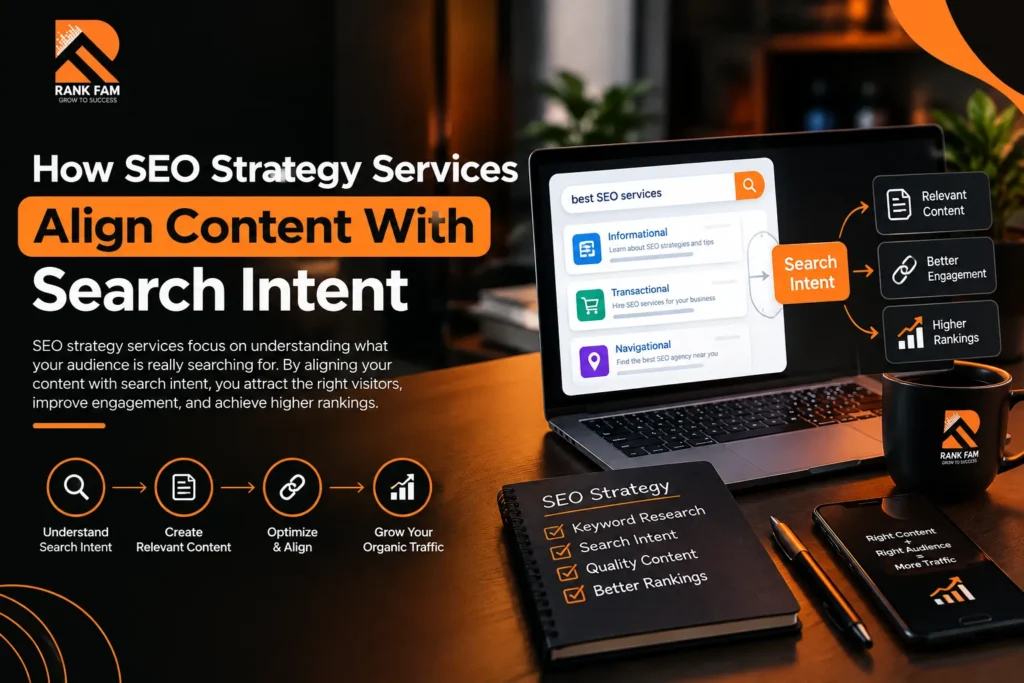
Search intent is the reason behind a search. A person who types “best running shoes for flat feet” wants help choosing. A person who types “running shoe store near me” wants to buy today. The words look alike, but the goals differ.
Google tries hard to read that goal. If your page does not match it, searchers leave fast, and rankings often slip. SEO strategy services start here because intent decides what kind of page you should build before you write a single line.
The Four Types of Search Intent
Most searches fall into four groups. Here is a quick view of each one:
| Intent Type | What the Searcher Wants | Page That Fits |
| Informational | To learn or understand | Guide, blog post, how-to |
| Navigational | To reach a known site | Home page, brand page |
| Commercial | To compare before buying | Review, comparison, list |
| Transactional | To buy or book now | Product or service page |
Look at the table again and ask yourself: which type does each of your pages target? Many owners find that a service page is trying to teach, or a blog post is trying to sell. Both miss the mark.
How Do You Find the Intent Behind a Keyword?
The simplest way is to search for the phrase yourself. Look at the first page of results. Do you see guides, product pages, or a mix? Google shows what it believes users want, so the results act like a free answer sheet.
Next, check the extra features on the page. A “People Also Ask” box points to questions you should answer. A map pack tells you the search is local. Shopping results mean buyers are ready. Each clue shapes the page you should write.
Studies back up how much position matters. Backlinko’s analysis of millions of search results found that the top result earns about 27 percent of clicks. That share falls sharply further down the page. So matching intent is not a small tweak. It can decide whether anyone ever sees your page.
Build a Keyword Plan Around Intent
Good keyword work does more than list popular phrases. It sorts them by intent and gives each group a home page.
Start with a main phrase for each page. Add close variations and related terms that fit naturally. Then look at longer phrases, such as “how much does a small business website cost.” These have fewer searches, but the people behind them are often closer to acting. They are also easier to win, which makes them a smart place to start for newer sites.
Avoid putting two pages against each other for the same phrase. This is called keyword cannibalization, and it confuses search engines. One page per main intent keeps your plan clean.
Shape the Page to Fit the Search
Once you know the intent, build the page to match.
For informational searches, answer the question near the top, then add detail. Use clear sub-headings, short paragraphs, and a list or table if it helps. For commercial searches, compare options fairly and show real facts. For transactional searches, keep the page simple, with clear prices, proof, and an easy way to act.
Google’s guidance on helpful content asks writers to share real knowledge and give readers a satisfying answer. Pages that read like they came from someone who has done the work tend to fit that advice best.
A Story From Our Own Work
Last year, we worked with a small accounting firm. Their blog had thirty posts, but nearly all of them tried to sell services. People who wanted to learn about taxes found no clear answer, so they left.
We sorted every post by intent. Then we rewrote eight of them as plain guides with real examples, simple tables, and short answers near the top. We also moved the sales message to the service pages, where buyers expected it. We added internal links from each guide to the matching service page.
After about four months, six of those eight guides reached page one. Calls from the website rose, and the new visitors stayed longer on each page. The owner told us the best part was that we did not need to write thirty new posts. We only needed to put each page where it belonged.
Use Internal Links to Guide Readers
Internal links connect your pages and show search engines how they relate. A guide that explains a topic can link to a service page for readers who want help. A service page can link to a guide for readers who want to learn first.
Use short, clear link text that tells the reader what they will find. Avoid “click here.” Good linking leads each visitor from learning to action without pushing.
Track Results and Adjust
A plan needs proof that it works. Use free tools like Google Search Console and Google Analytics. Watch these numbers each month:
- Clicks and impressions for each target phrase
- Average ranking position
- Time spent on each page
- Calls, form fills, or sales from the page
Give each change at least six to twelve weeks before judging it. Rankings move slowly, and quick decisions can undo good work. If a page ranks well but gets few clicks, rewrite the title and description. If it gets clicks but no action, check whether the page still matches intent.
Common Mistakes to Avoid
Many businesses repeat the same errors:
- Writing sales pages for people who want to learn.
- Using one page to chase many unrelated phrases.
- Copying rival pages instead of adding something new.
- Ignoring mobile readers.
- Judging results after only two weeks.
Fixing even two or three of these can lift a site faster than writing new content.
When to Bring in a Partner
Small sites can handle the basics alone. Sort your pages by intent, fix titles, and fill missing answers. If you manage a large site, sell in a tough market, or lack time, a trained team can speed things up. Ask any provider for clear reports, real examples, and a plan that talks in months, not days. If your business serves a place like your service area, pick a team that understands your local buyers.
Conclusion
SEO strategy services connect what you write with what people want to find. They start with intent, build keyword plans around it, and shape each page to fit. Results come slowly, but they stay, and they often cost less than constant ads. Start by sorting your pages by intent, fix the biggest mismatches first, and track each change. Steady, small steps will move your site ahead of rivals who guess instead of plan.
Frequently Asked Questions
How long does it take to see results from an SEO plan?
Most sites show early movement in two to three months. Stronger gains often arrive after six months of steady work. Speed depends on your market, your site’s age, and the quality of your pages. Be careful with any provider who promises a top spot in a few days.
How much do these services cost?
Prices depend on site size, market difficulty, and the work you need. Some firms charge a monthly fee, while others price by project. Ask for a written list of tasks and a clear price for each one. This helps you compare offers and spot hidden fees early.
Can I match content to search intent without help?
Yes, small sites can do the basics alone. Search your main phrase, study the top results, and write a page in the same format with better answers. Free tools give you the data you need. If your site grows or time runs short, a partner can take on the heavy work.
Does one page need to target only one intent?
In most cases, yes. A page with a clear goal is easier for readers and search engines to understand. You can mention related ideas, but the main purpose should stay focused. If two goals compete, split them into two pages and link them together.
What is the difference between SEO and content writing?
Content writing creates the words on a page. SEO makes sure the right people can find those words. The two work best together. A well-written page that matches no search goes unseen, while a page built only for search engines often reads poorly. Good plans balance both.