Launching a Shopify store is easy. Getting people to actually find it is the hard part. Have you ever built out a beautiful storefront, only to check your analytics and see almost no visitors coming from search?
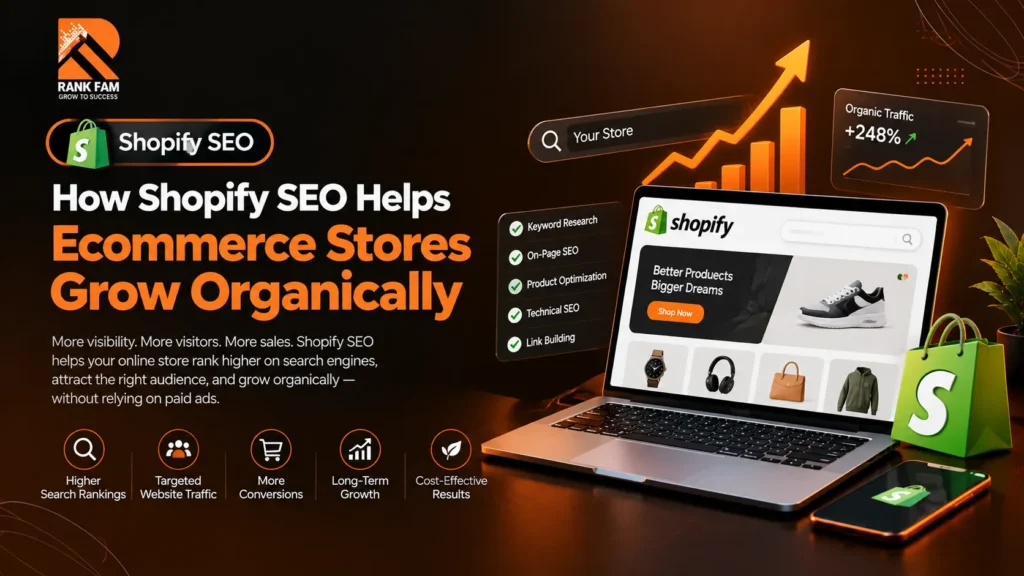
You’re far from alone. With over 6.9 million live Shopify stores currently running, standing out takes more than a nice theme and good product photos. Rank Fam works with Shopify merchants to fix exactly this problem through Shopify SEO Services, built around what actually moves rankings on this specific platform. This guide breaks down what Shopify SEO involves, why it matters so much for long-term growth, and where most stores lose visibility without realizing it.
What Makes Shopify SEO Different From General SEO
Shopify SEO Services cover the same core principles as general SEO, but they account for how Shopify’s platform actually works. This includes its fixed URL structure, app-driven page speed issues, and the way collection pages and product pages compete for the same search terms.
A general SEO plan built for any random website won’t always translate cleanly to Shopify’s setup. Store owners need an approach shaped around Shopify’s specific quirks, from how its sitemap gets generated automatically to how third-party apps can quietly slow down page load times.
Why So Many Shopify Stores Struggle to Rank
Here’s a sobering statistic worth sitting with: only 1 in 10 new Shopify stores remain active 90 days after launch. A big part of that drop-off traces back to stores that never built a real path for customers to find them beyond paid ads.
Organic search remains one of the strongest channels available once it’s set up correctly. Data shows organic traffic converts at around 2.8% for ecommerce stores, compared to just 0.8% to 1.2% for paid social traffic, meaning organic visitors buy at roughly three times the rate. On top of that, schema markup, the structured data that tells search engines exactly what a product is, its price, and its stock status, appears on 73% of top-ranking ecommerce pages, yet it’s frequently missing or misconfigured on smaller Shopify stores.
That gap between what works and what’s actually implemented is where Shopify SEO Services make the biggest difference. Stores that fix these gaps tend to build a traffic source that keeps performing long after any single ad campaign ends.
Where to Focus First: Collections vs. Products
One decision trips up a lot of Shopify merchants early on. Should keyword efforts focus on collection pages or individual product pages? Here’s a side-by-side comparison to make that clearer.
| Page Type | Best For | Typical Search Intent | Ranking Difficulty |
| Collection Pages | Broad, high-volume terms | Commercial (browsing/comparing) | Medium to High |
| Product Pages | Specific, long-tail terms | Transactional (ready to buy) | Lower |
| Blog/Guide Pages | Informational, supporting content | Research and discovery | Lower to Medium |
Collection pages often carry more ranking weight since every product within them links back, building internal authority. Product pages, on the other hand, tend to be easier to rank for specific, longer search terms. A strong Shopify SEO strategy usually targets both, rather than putting all the effort into just one.
Fixing the Technical Side of Shopify Stores
Technical issues quietly hold back a lot of otherwise solid Shopify stores. Unused apps are a common culprit, since each one adds extra code that can slow page load times even after the app itself is no longer needed. Duplicate content is another frequent problem, often created by Shopify’s own URL structure generating multiple paths to the same product.
A regular technical review catches these issues before they cause real damage. Removing unused apps, cleaning up duplicate URLs, and submitting an updated sitemap to Google Search Console are simple steps that often produce noticeable improvements within weeks rather than months.
Content That Actually Supports Sales
Product descriptions matter more than many store owners assume, and generic manufacturer copy rarely performs well in search. Rewriting product pages with clear, specific details, along with adding buyer’s guides or comparison content, gives search engines more relevant material to rank while also helping shoppers make faster decisions.
Internal linking plays a supporting role here too. Linking related products and guides together helps both customers and search engines understand how your store’s catalog fits together, often unlocking rankings for search terms a store wasn’t specifically targeting before.
Common Mistakes That Hold Shopify Stores Back
A handful of mistakes show up again and again on underperforming Shopify stores. Treating SEO as a one-time setup task instead of ongoing maintenance is one of the most common, since search engines expect fresh, updated content over time. Ignoring collection page optimization in favor of only product pages is another, missing out on some of the highest-value search terms available. Skipping schema markup also holds stores back, even though it’s one of the more straightforward technical fixes available. And relying entirely on paid ads while never building organic traffic leaves a store vulnerable the moment ad budgets get cut.
None of these mistakes are difficult to fix once a proper audit identifies exactly where the gaps are.
Conclusion
Shopify SEO Services give store owners a real path to sustainable traffic instead of depending entirely on paid ads that stop working the moment spending stops. With millions of stores competing for attention and organic traffic converting at nearly three times the rate of paid social, the stores that invest in proper search optimization tend to build a real advantage over time. Fixing technical issues, targeting the right pages, and writing content that actually helps shoppers all work together to move the needle. Whether you’re just launching or trying to break past a plateau, the right approach turns search into one of your store’s strongest, most reliable channels. A full store audit is often the clearest way to see where your biggest opportunities are hiding.
Frequently Asked Questions
How long does it take to see results from Shopify SEO?
Most stores see measurable ranking improvements within three to six months after implementing technical and on-page fixes. More competitive product categories can take six to twelve months. Consistent, ongoing work tends to produce better results than a single round of changes.
Should I focus on product pages or collection pages first?
Both matter, but collection pages often carry more ranking weight since they target higher-volume search terms and receive internal link support from every product within them. Product pages tend to rank more easily for specific, longer search terms. A balanced approach usually works best for most stores.
Do Shopify apps really affect SEO performance?
Yes, unused or poorly built apps can add extra code that slows page load times, which affects both rankings and conversions. Reviewing installed apps regularly and removing ones that are no longer needed is a simple but effective maintenance step. Page speed remains one of the more overlooked technical factors on Shopify stores.
Is Shopify SEO different from SEO on other ecommerce platforms?
Yes, Shopify has its own URL structure, automatic sitemap generation, and app ecosystem that all affect how SEO work gets implemented. While the core principles of search optimization stay the same, the specific technical steps often differ from platforms like WooCommerce or Magento. Working with someone familiar with Shopify’s setup usually speeds up the process.
Can a small Shopify store compete with larger, established competitors?
Yes, smaller stores often find success by targeting more specific, less competitive search terms rather than trying to outrank major retailers on broad category terms. This approach, often called long-tail targeting, can bring in highly relevant traffic even with a smaller catalog. Consistency tends to matter more than store size in the long run.
Do product reviews help with Shopify SEO?
Yes, reviews add fresh, relevant content to product pages and can be marked up with schema to display star ratings directly in search results. This combination tends to improve both click-through rates and trust signals search engines rely on. Encouraging customers to leave reviews after purchase is a simple way to build this over time.