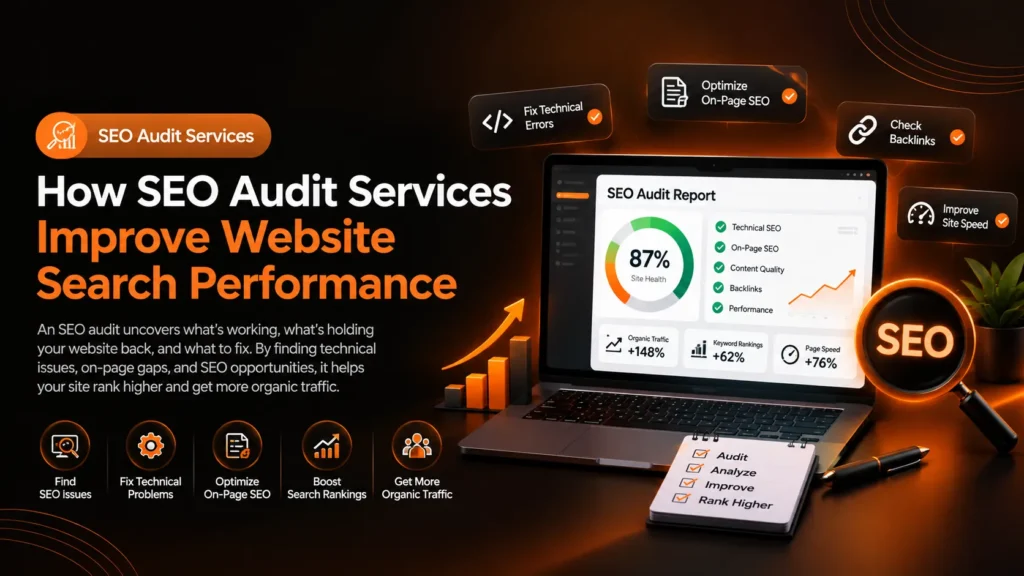
Your website can look great and still sit on page four of Google. Slow pages, broken links, and thin content hide in the background, and you never see them. That is where SEO audit services come in. An audit shows what holds your site back and what to fix first.
At Rank Fam, we run SEO audit services for small and mid-size sites that want steady search growth. In this post, we explain what an audit covers, how it improves search performance, and how to use the results. Sounds useful?
What Are SEO Audit Services?
SEO audit services are a full health check for your website. A specialist reviews your technical setup, your page content, and your backlinks, then lists every problem that may hurt your rankings. Good SEO audit services rank those problems by impact, so you know where to start.
Think of a car service. A mechanic doesn’t guess why the engine rattles. They run tests and write a list. SEO audit services do the same for your site, using crawlers, Google Search Console, and manual review to find the cause behind low traffic.
Why Your Website Needs an SEO Audit
Search engines change, and websites change too. New pages, plugin updates, and redesigns can break things without warning. Regular SEO audit services catch those slips early. The data shows why this matters. The 2025 Web Almanac from HTTP Archive found that only 48% of mobile websites pass all three Core Web Vitals, which are Google’s measures of loading speed, responsiveness, and visual stability.
Speed affects real people. Google research on mobile speed, widely cited across the industry, shows that 53% of mobile visitors leave a page that takes more than three seconds to load. If your pages are slow, SEO audit services will flag it, and fixing it keeps visitors on the page long enough to buy or call.
Take a local bakery with a new online shop. Sales are flat, so the owner writes more blog posts. An audit finds the real issue: product pages load slowly, and half of them share the same title tag. Fixing those two things does more than ten new posts. SEO audit services point you to the real problem, not the loudest one.
What SEO Audit Services Check
A strong audit looks at four main areas: technical health, on-page content, backlinks, and user signals. Here is a quick view of what SEO audit services usually cover.
| Audit area | What we look for | Why it matters |
| Technical SEO | Crawl errors, broken links, redirects, sitemap, HTTPS, mobile layout | Google must reach and read your pages |
| Site speed | Core Web Vitals, image size, heavy scripts | Fast pages keep visitors and rank better |
| On-page SEO | Title tags, meta descriptions, headings, duplicate content | Pages need to match what people search |
| Content quality | Thin pages, outdated posts, gaps against competitors | Helpful content earns trust and clicks |
| Backlinks | Link quality, spammy links, missing opportunities | Good links signal authority |
| Local and schema | Business listings, structured data | Rich results and map visibility |
A competitor check often sits on top of this list. Comparing your pages with the top results shows content gaps you can fill, and SEO audit services turn those gaps into a to-do list.
How SEO Audit Services Improve Search Performance
First, they fix crawling and indexing. If Google can’t crawl a page, it can’t rank it. Audits find blocked pages, redirect chains, and missing sitemap entries. After a fix, more of your pages enter Google’s index, and SEO audit services often show quick gains here.
Next, they speed up your site. Compressing images, trimming scripts, and fixing layout shifts help pages pass Core Web Vitals, which Google confirmed as a ranking signal. Faster pages keep people longer, and SEO audit services give your developer a clear list to work from.
Then, they sharpen your content. Audits spot pages that target the same keyword, pages with thin text, and titles that don’t match search intent. Google’s own guidance says to create helpful, people-first content. SEO audit services show which pages miss that mark and what to add.
They clean up your link profile too. Toxic or spammy links can drag a site down. Strong local and industry links lift it. SEO audit services flag both, along with broken internal links that waste authority.
Finally, they connect traffic to sales. A page can rank and still earn nothing if the call button is hidden. Good SEO audit services check forms, calls to action, and mobile layout, so more visitors become leads.
How to Read and Use Your Audit Report
A long report can feel heavy. Don’t try to fix everything at once. Sort the findings into three groups: fix now, fix soon, and fix later. Errors that block crawling or hurt mobile use go first. SEO audit services from a good team arrive already sorted this way.
Set a clear owner and a date for each task. Your developer may handle speed and redirects. Your writer may handle titles and thin pages. After each batch of fixes, check Google Search Console for changes in clicks, impressions, and indexed pages. Track the numbers so SEO audit services lead to proof, not just a PDF.
How Often Should You Run an Audit?
Most sites need a full audit once or twice a year. Run one sooner after a redesign, a platform move, or a sudden drop in traffic. Large stores and news sites may need monthly checks. Regular SEO audit services keep small problems from growing into ranking losses.
Can you do it yourself? Free tools such as Google Search Console and PageSpeed Insights give a good start. They won’t show every issue or explain which ones matter most. Paid SEO audit services add expert review, competitor data, and a clear plan, which saves time.
Conclusion
SEO audit services give your website a clear map. They show what blocks crawling, slows pages, weakens content, and wastes links. Fixing those problems in the right order lifts rankings and keeps visitors on your pages. Run an audit once or twice a year, work through the list by priority, and track the results in Search Console. If you want expert help, Rank Fam is ready to review your site and build a plan that fits your goals.
FAQs
How long does an SEO audit take?
A small site can be reviewed in a few days. Larger sites with thousands of pages may take two to three weeks. The time depends on site size, the number of tools used, and how deep the review goes. Ask for a delivery date before you start.
What does a typical audit report include?
You should get a list of technical errors, page-level problems, content gaps, and link issues. A good report ranks each item by impact and effort. It also includes screenshots, page links, and clear steps to fix each problem. You shouldn’t need a developer to read it.
Will an audit fix my rankings on its own?
No, an audit only finds the problems. Rankings improve after your team fixes them and Google crawls the changes again. That can take a few weeks to a few months. Think of the report as the plan and the fixes as the real work.
How much does an audit cost?
Prices vary by site size, industry, and how detailed the review is. A small business site costs far less than a large online store. Ask what is included, such as competitor research, a backlink review, and a follow-up call. Compare the scope, not just the price.
What tools are used in an audit?
Most specialists use Google Search Console, Google Analytics, a site crawler, and a speed tool like PageSpeed Insights. They add backlink and keyword tools to check links and rankings. Tools find the data, but a person has to read it and decide what matters most for your goals.
What is the difference between a technical audit and a content audit?
A technical audit checks how search engines crawl and load your site. It covers speed, redirects, mobile layout, and indexing. A content audit checks the pages themselves, such as titles, headings, text quality, and keyword fit. Most full audits cover both so nothing slips through.