You list a great product, add clear photos, and set a fair price. Then nothing happens. Why does a good product page get so few visitors? Most of the time, search engines can’t tell what the page offers, or shoppers don’t trust it enough to buy. Ecommerce SEO services fix both problems.
At Rank Fam, we work with online stores that want more sales from search. In this guide, we explain how ecommerce SEO services improve product page optimization, what they change on each page, and how to pick a team that does the work well.
What Are Ecommerce SEO Services?
Ecommerce SEO services help an online store show up in search results for the products it sells. They cover product pages, category pages, site structure, speed, and links. The goal is simple: bring in shoppers who are ready to buy, not just visitors who browse and leave.
Product pages sit at the center of this work. Each one is a small landing page. Ecommerce SEO services treat every page as a chance to match a real search, such as “waterproof hiking jacket for women.”
Why Do Product Pages Need Special Care?
Search is a big source of store traffic. Similarweb’s 2025 benchmark report put organic search at 23.56% of ecommerce traffic, the second-largest channel after direct visits. Other reports give higher figures, so treat any single number as a guide. Still, ecommerce SEO services target a channel that brings steady, unpaid visitors.
Speed matters just as much. A Deloitte study for Google found that a 0.1-second faster mobile load time lifted retail conversion rates by 8.4%. Tiny delays cost sales, so ecommerce SEO services check speed on every product template.
Google also gives clear help. Its Search Central guidance on product structured data explains how price, stock status, and ratings can appear right in the results. Good ecommerce SEO services use this markup so your listings stand out.
How Do Ecommerce SEO Services Improve Product Page Optimization?
Here are the main fixes we make, page by page.
Product Titles and Keywords
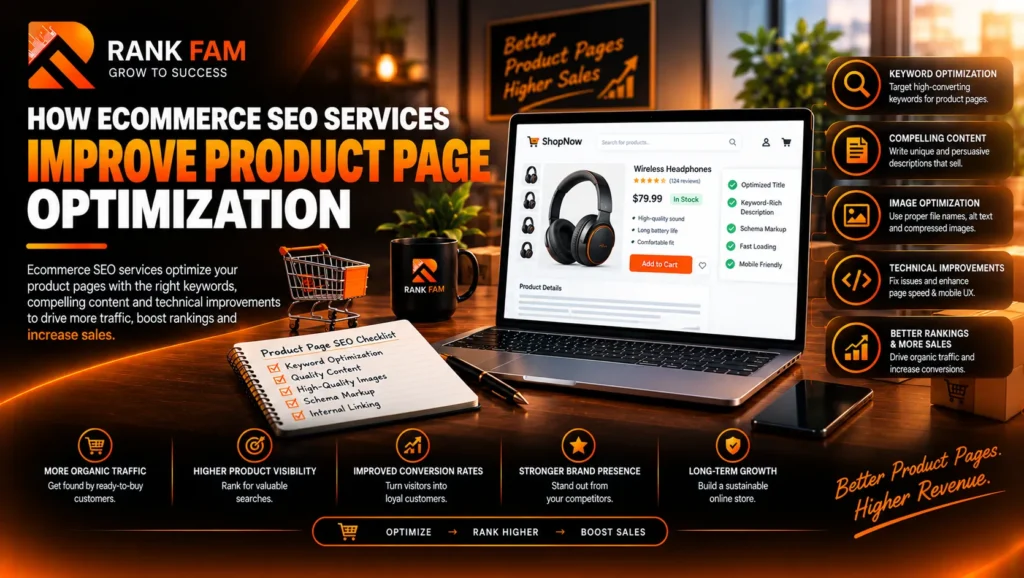
A title like “Item 4471” tells no one anything. We write titles that include the product type, a key feature, and the brand, such as “Men’s Waterproof Hiking Jacket, Lightweight.” Ecommerce SEO services also choose long-tail keywords, which are longer phrases with clearer buying intent and less competition.
Unique Product Descriptions
Many stores copy the supplier’s text. Hundreds of other shops use the same words, so search engines see nothing new. Ecommerce SEO services replace that copy with original descriptions that answer real questions about size, material, use, and care.
Images and Alt Text
Shoppers want to see what they buy. We compress images so they load fast and add short alt text that describes each photo in plain words. Ecommerce SEO services also name image files clearly, which helps your products appear in Google Images.
Schema Markup and Rich Results
Schema is extra code that tells search engines what a page contains. For products, it can show price, availability, and star ratings. Ecommerce SEO services add and test this code, so your listing can earn more clicks than a plain one.
Reviews and Internal Links
Reviews build trust and add fresh, useful text. We also link related products and guides to each other, so shoppers and search crawlers move through the store with ease. Ecommerce SEO services plan these links with care.
This table shows common product page problems and how we fix them.
| Page element | Common problem | Typical fix |
| Title tag | Vague or too long | Short, clear title with the main keyword |
| Description | Copied from the supplier | Original text with details shoppers need |
| Images | Large files, no alt text | Compress and add plain alt text |
| Schema | Missing price or rating data | Add product markup and test it |
| Variants | Many near-duplicate URLs | Use canonical tags to point to one page |
| Page speed | Heavy scripts and apps | Remove extras, enable caching |
What About Out-of-Stock and Duplicate Pages?
This is where many guides stop, yet it causes real trouble. When a product sells out, some stores delete the page. That throws away the links and rankings the page earned. Ecommerce SEO services keep the page live, show a clear “back in stock” note, and suggest similar items. If the product is gone for good, they redirect it to the closest match.
Color and size options bring a related problem. Each variant can create its own URL with almost the same content. Ecommerce SEO services use canonical tags to tell search engines which version counts, so the ranking power stays in one place.
A Simple Example
Here is a made-up case. A small online store in Perth sells camping gear. Its tent pages use supplier text, have no alt text, and load slowly on phones. Ecommerce SEO services rewrite the titles, add original descriptions, compress the photos, and set up product schema. Over several months, the tent pages begin to appear for long-tail searches like “two person tent for windy weather,” and more of that traffic turns into orders.
How Do You Choose Ecommerce SEO Services?
Ask for a product page audit first. A good team looks at real pages from your store and shows what they would change. Ecommerce SEO services that only send a generic checklist are not worth the fee.
Ask how they handle large catalogs. Writing every title by hand takes too long for a store with thousands of products. Good ecommerce SEO services use templates, then add custom work to your best sellers.
Watch for red flags too. Promises of page one in a week, bought links, and no monthly reports all signal trouble. Honest ecommerce SEO services tell you that results take months and show you how they will track sales, not just rankings.
Conclusion
Product pages win or lose the sale. Ecommerce SEO services improve titles, descriptions, images, schema, and speed so search engines understand your products and shoppers trust them. They also handle the messy parts, such as sold-out items and duplicate variants. At Rank Fam, we start with your best-selling pages and build from there. If your store gets visits but few orders, a product page review is a good first step.
Frequently Asked Questions
How much do ecommerce SEO services cost?
Price changes with the size of your catalog, your platform, and how much work you need each month. A small store with fifty products costs far less than a large shop with thousands. Ask for a clear scope and a sample report before you agree. Very cheap plans usually mean very little work.
How long does it take to see results?
Fixes to speed, titles, and schema can show gains within a few weeks, once Google recrawls the pages. Content and link work often take three to six months to build momentum. Competition and your starting point both play a part, so track orders and clicks each month.
Which platforms work best for SEO?
Shopify, WooCommerce, and BigCommerce all work well when they are set up with care. Each has its own quirks. Shopify can create duplicate collection URLs, and WooCommerce can slow down with too many plugins. The right fixes depend on your platform, so ask the provider how they handle yours.
Do I need to write every product description by hand?
Not always. Start with your best sellers and the pages that already get visits. Write original text for those, and use clear templates for the rest. Add real details like size, material, and care. Copying supplier text across hundreds of pages is the habit to avoid.
Do product reviews help SEO?
Yes, they help in two ways. Reviews add fresh, natural text that matches how shoppers talk. With schema markup, star ratings can also show in search results, which often raises clicks. Ask buyers for reviews after delivery, and reply to the negative ones in a calm, helpful way.