You publish a page, wait a few weeks, and nothing happens. Sound familiar? Many owners think they need more backlinks or a bigger budget. Often the real problem sits on the page itself. That is where on page SEO services step in.
At Rank Fam, we review on page SEO every week, and we see the same pattern. Good businesses have weak titles, thin pages, and messy links. In this post, we explain what on page SEO services cover, how they lift rankings, and what you can check on your own site today.
What Are On Page SEO Services?
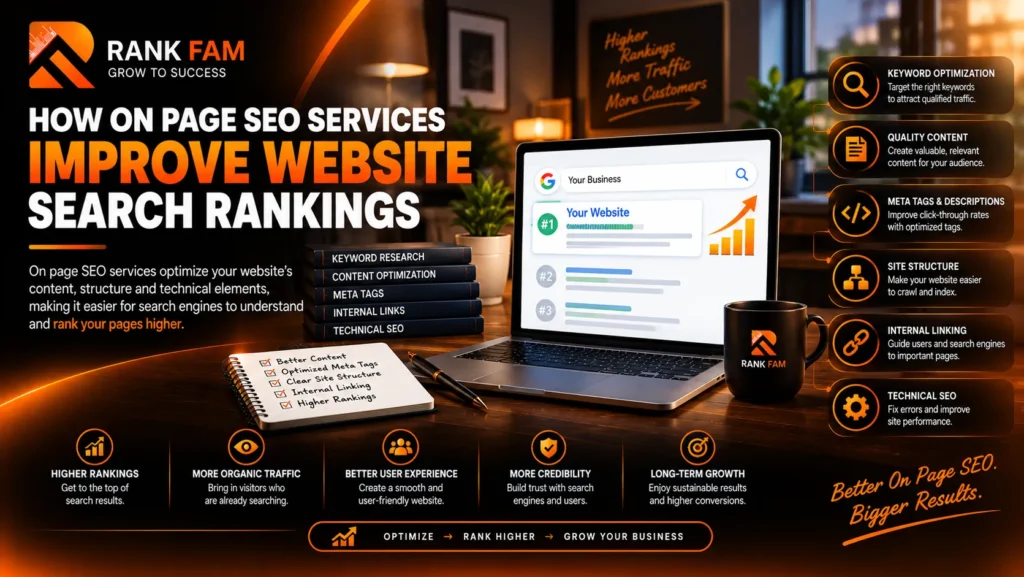
On page SEO services cover everything we change on your own pages to help search engines understand them. That means titles, headings, text, images, links, and page speed. Off page work, like backlinks, happens on other sites. On page work happens on yours, so you stay in control.
Think of a page as a shop window. Google is the person walking past. If the sign is vague and the display is messy, they keep walking. Clear signs bring people in, and good on page optimization does the same job in search results.
Why Rankings Start on the Page
Google wants to show the best answer for each search. It reads your page to decide if you have it. When your page is unclear, Google guesses, and guesses rarely work in your favor.
A 2024 Semrush study, cited by Ideamagix, found that 73% of low-ranking sites failed basic on page checks even with strong backlink profiles. That tells us something simple. Strong links cannot fix a weak page. Good on page SEO services fix the base first, so every other effort has something solid to stand on.
Title Tags and Meta Descriptions
The title tag is the first thing people read in search results. A good one names the topic in plain words and keeps the main keyword near the front. Backlinko’s study of millions of Google results found that titles between 40 and 60 characters had a 33.3% higher click rate than titles outside that range. Ahrefs data shows Google is 57% more likely to rewrite titles that run too long.
Meta descriptions do not lift rankings directly, but they win clicks. Strong on page SEO services write both for people first. Would you click a result that reads like a list of keywords? Neither would we.
Content That Matches Search Intent
Search intent is what a person really wants when they type a query. Say a plumber’s page targets “water heater repair” but only tells the company story. Visitors leave fast, and Google notices. A rewrite that covers cost, repair time, and common problems keeps people reading.
Our on page SEO services start by matching each page to one clear intent. Then we add related terms and long-tail phrases, like “water heater repair cost near me,” in a natural way. We never repeat a keyword just to hit a number. Readers and search engines can both tell when a page tries too hard.
Headings, URLs, and Internal Links
Headings give a page its skeleton. One H1 states the main topic. H2s and H3s split the rest into parts, so readers can scan quickly. Short, clean URLs help too. A slug like /on-page-seo-services reads better than /page?id=482.
Internal links connect your pages and show Google which ones matter. Use anchor text that describes the target page, such as “local SEO checklist,” not “click here.” Add plain-language alt text to images as well. It helps screen readers and image search. If you want a team to map this page by page, our SEO services cover it from audit to fix.
Here is a quick view of what we check and why it matters:
| On page element | What we check | Likely result |
| Title tag | 40 to 60 characters, keyword near the front | Higher click rate |
| Meta description | Clear summary under 160 characters | More clicks from results |
| Headings | One H1, logical H2s and H3s | Easier scanning |
| Internal links | Descriptive anchors, no orphan pages | Better crawling |
| Image alt text | Short, accurate description | Image search and access |
| Schema markup | Article, FAQ, or Product type | Rich results |
| Page speed | Image size, extra scripts | Fewer people leaving |
Schema Markup and Page Speed
Schema markup is code that tells search engines what a page contains, like FAQs, reviews, or products. It can earn rich results, which stand out on the results page. One Launchcodex report says pages with schema markup earn rich results with 82% higher click rates than standard listings.
Speed matters too. Slow pages lose visitors before they read a word. Compress large images, remove extra scripts, and test on a phone. Core Web Vitals are Google’s measures of loading and stability. Deeper server work belongs to technical SEO, but many quick wins sit inside on page SEO services.
Common Mistakes We Fix
Most sites we review share a few problems:
- Duplicate or missing title tags
- Pages that stuff the same keyword in every line
- Thin pages with fewer than a few hundred words
- Orphan pages that no other page links to
- Images with no alt text
- Pages that look broken on a phone
None of these are hard to fix. They just need someone to look at the pages one by one. Why do so many sites skip this? Most teams treat on page work as a one-time task, then move on to the next campaign.
How Long Do Results Take?
Nobody can promise a fixed date, and we avoid anyone who does. Many sites see early movement within one to two months, based on how competitive the topic is. Pages with low competition often move first.
We track progress in Google Search Console. We watch clicks, impressions, and average position for each page we change. If a page gains impressions but few clicks, we rework the title. If it gets clicks but people leave, we rework the content. Good on page SEO services never stop at the first edit.
Conclusion
On-page work is the base of every ranking plan. Clear titles, helpful content, clean links, schema, and fast pages all tell Google what your site offers. Weak pages hold back even the best link building, so fixing them first pays off. On page SEO services give you that base and keep it healthy as your site grows. If you serve nearby customers, pair this work with local SEO so the right people in your area find the right page.
Frequently Asked Questions
What are on page SEO services?
They are a set of fixes made directly on your web pages to help them rank. The work covers titles, meta descriptions, headings, content, images, internal links, and page speed. The goal is to make each page clear to search engines and easy for visitors to use.
How long does on page SEO take to show results?
Many sites see early changes in one to two months, though this depends on your industry and competition. Small pages with low competition often move faster. Bigger, tougher topics can take several months of steady updates.
Is on page SEO different from technical SEO?
Yes. On page SEO handles what you can see and edit on a page, like text, titles, and links. Technical SEO covers behind-the-scenes items, like crawling, indexing, and server speed. Both work best when they run side by side.
How many keywords should one page target?
Each page should have one main keyword and a few close variations. This keeps the page focused and helps it match a clear search intent. Trying to rank one page for many unrelated terms usually weakens all of them.
Can I do on page SEO myself?
You can handle the basics, like writing clear titles and adding alt text to images. Larger sites, though, need audits, content plans, and schema setup that take time and practice. Many owners start on their own and bring in help when the page count grows.
How much do on page SEO services cost?
Pricing depends on how many pages you have and how much work each one needs. A small site might need a short project, while a large store needs ongoing support. A good provider will review your pages first, then give a clear quote.