You publish a new blog post every week. You spend hours on each one. Yet traffic barely moves. Does that sound like your site?
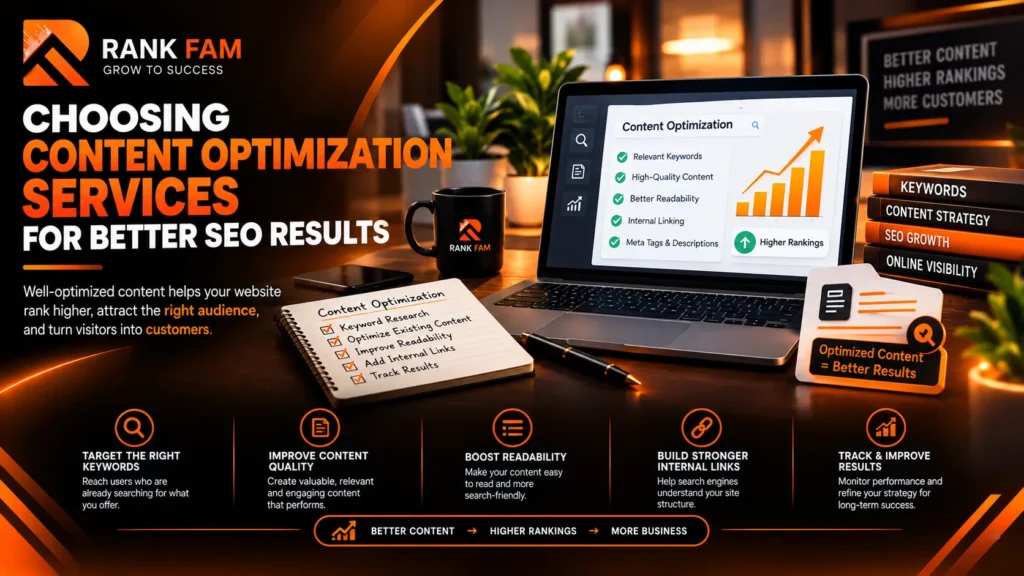
Most owners think they need more content. In truth, they often need better content. That is where content optimization services come in. At Rank Fam, we fix pages that already exist so they can rank, earn clicks, and bring in real leads. In this guide, we explain what content optimization services do, how to pick a good provider, and which warning signs to watch for.
What Are Content Optimization Services?
Content optimization services improve the pages you already have so search engines can understand them and readers enjoy them. The work includes updating text, fixing headings, adding missing topics, cleaning up titles, and linking pages together.
Think of it like renovating a house instead of building a new one. The structure is there. It just needs smarter use of space.
Why does this matter? Many pages never get a chance. An Ahrefs study of nearly one billion pages found that 90.63% receive no organic traffic from Google. Most of those pages are not terrible. They simply miss what searchers want, or they sit on a site with no clear structure.
Why Old Content Often Beats New Content
Writing a fresh post takes time, and a new page may need months to rank. An older page already has some age, links, and history. A few smart changes can lift it much faster.
HubSpot reported that updating and republishing old blog posts helped the company grow organic views on those posts by an average of 106%. That case shows how much hidden value sits in pages you published long ago.
We saw the same thing with a small accounting firm. Their post on “self-employed tax deadlines” sat on page three for over a year. We added current dates, a simple checklist, and answers to five common questions. Within eight weeks, the page moved to the first page and started bringing in calls.
What Good Content Optimization Services Include
Not every provider does the same work. Here is a quick table to help you compare what a solid package should cover.
| Task | What It Does | Why It Matters |
| Content audit | Reviews every page for traffic and quality | Shows which pages to fix first |
| Keyword mapping | Matches one main phrase to each page | Stops pages from competing |
| Search intent match | Aligns page type with what people want | Raises time on page and rankings |
| Gap analysis | Finds topics rivals cover that you skip | Makes your page more complete |
| Title and heading fixes | Improves tags and structure | Helps clicks and clarity |
| Internal linking | Connects related pages | Passes strength to weak pages |
| Refresh and update | Adds new facts and removes old ones | Keeps content trusted |
If a provider skips the audit and jumps straight to rewriting, be careful. You need a plan before you touch a single word.
Step 1: The Content Audit
A good audit sorts your pages into four groups: keep, update, merge, or delete. Pages with steady traffic usually stay. Pages that rank on page two or three get updated first, since they are close to a win. Pages that cover the same topic get merged. Pages with no traffic and no value get removed.
This step saves money. You focus effort where it pays back fastest.
Step 2: Match Search Intent
Search intent means the reason behind a search. Someone typing “how to fix a leaking tap” wants steps. Someone typing “best plumber near me” wants a company to hire. If your page gives a sales pitch to the first person, they leave.
Content optimization services study the top results and see what Google already rewards. Do they show lists, guides, videos, or comparisons? We then shape your page to fit that pattern while adding something better.
Google’s own guidance on helpful content says pages should be written for people first, not for search engines. We agree. Rankings follow usefulness.
Step 3: Fill Content Gaps
A content gap is a topic your rivals cover that you leave out. Maybe their page answers cost, time, and common mistakes, while yours only covers the basics.
We list the top ten results for your main phrase and note every subtopic they share. Then we add the missing parts to your page, along with fresh details they skip. This gives readers a full answer in one place, and that tends to keep them on the page longer.
Step 4: Fix On-Page Details
Small details add up. We check the title tag, meta description, headings, image text, and URL. The main keyword should appear near the start of the title and in the first 100 words. Related terms should appear naturally across the page.
We never stuff keywords. If a sentence sounds strange when read out loud, we rewrite it. Search engines now understand meaning, so natural writing works better than repeating one phrase again and again.
Step 5: Strengthen Internal Links
Many sites have strong pages that never share their strength. We add links from popular pages to pages that need a lift, using clear anchor text such as “our guide to local SEO checklists” instead of “click here.”
This also helps visitors find more of your content, which can raise time on site and lead to more inquiries.
How to Choose the Right Provider
Picking a partner takes some care. Here are questions we suggest you ask:
- Do they start with an audit, or do they sell a fixed package first?
- Can they show past results with real before-and-after numbers?
- Do they explain their steps in plain language?
- Do they promise first-place rankings? If yes, walk away. No one controls Google.
- Do they write original content, or do they spin old text?
- Will you get clear monthly reports?
Which of these matter most to you? Write down your top three before you speak to any provider.
Warning Signs to Watch For
Some red flags show up again and again. Be careful if a provider offers very low prices with huge promises, will not share how they work, or fills your pages with the same keyword in every line. Also avoid anyone who uses automated tools to rewrite your pages without human checks. Thin, copied, or machine-spun text can hurt your site instead of helping it.
How Long Do Results Take?
Small updates, like better titles and headings, may show movement in two to four weeks. Full page refreshes often take two to three months. Competitive terms can take longer.
The good part is that the gains last. A well-built page can keep earning traffic for years with only light updates.
Conclusion
Content optimization services help you get more from the pages you already own. The best providers start with an audit, match each page to search intent, fill topic gaps, fix on-page details, and link pages together. You can try small updates yourself, starting with your near-winning pages. For faster and safer progress, a trained team can set priorities and avoid costly mistakes. We help site owners across the United States and other English-speaking countries turn average pages into steady sources of leads.
FAQs
What are content optimization services?
Content optimization services improve existing web pages so they rank better and serve readers well. The work covers audits, keyword matching, rewriting, heading fixes, and internal links. The goal is to bring more of the right visitors to pages you already have, without starting from scratch.
How much do content optimization services cost?
Prices depend on how many pages you have and how much work each needs. Some providers charge a monthly fee, while others quote per page or per audit. A small site often starts with a one-time audit, then adds monthly work once early gains appear.
How often should I update my content?
Pages that cover fast-changing topics, such as prices or laws, may need a check every few months. Evergreen pages can often wait six to twelve months. Pages that lose traffic or slip in rankings should move to the front of the line.
Can I optimize my content without hiring anyone?
Yes, you can handle many tasks on your own. Start by updating old facts, improving your titles, and answering common questions on the page. If you have hundreds of pages or face strong rivals, a trained team can save time and spot gaps you may miss.
How do I know if content optimization is working?
Watch your rankings, clicks, and time on page each month. Free tools like Google Search Console show which searches bring people to each page. If these numbers rise over two or three months, the updates are doing their job.
What is the difference between content optimization and content writing?
Content writing creates new pages from scratch. Content optimization improves pages that already exist by fixing structure, filling gaps, and matching what searchers want. Most sites need both, but optimization often gives faster returns because the page already has some history with Google.