A site with 50 pages is easy to manage. A site with 50,000 pages is a different story. Titles go missing, old posts pile up, and three teams write about the same topic without knowing it. That’s the problem enterprise SEO services are built to solve. At Rank Fam, we work with large sites where small content mistakes repeat thousands of times. In this guide, we show how the right approach turns messy content into pages that rank.
What Are Enterprise SEO Services?
Enterprise SEO services are search optimization plans made for big websites. Think of online stores with huge catalogs, news sites, banks, universities and companies with several brands or countries. These sites have many pages, many writers and many developers, so the work needs structure and clear rules.
A small business can fix a title in two minutes. A large company may need to fix it across 20,000 product pages, and every change needs approval. Good enterprise SEO services handle both the strategy and the teamwork behind it.
Why Content Optimization Gets Hard on Big Sites
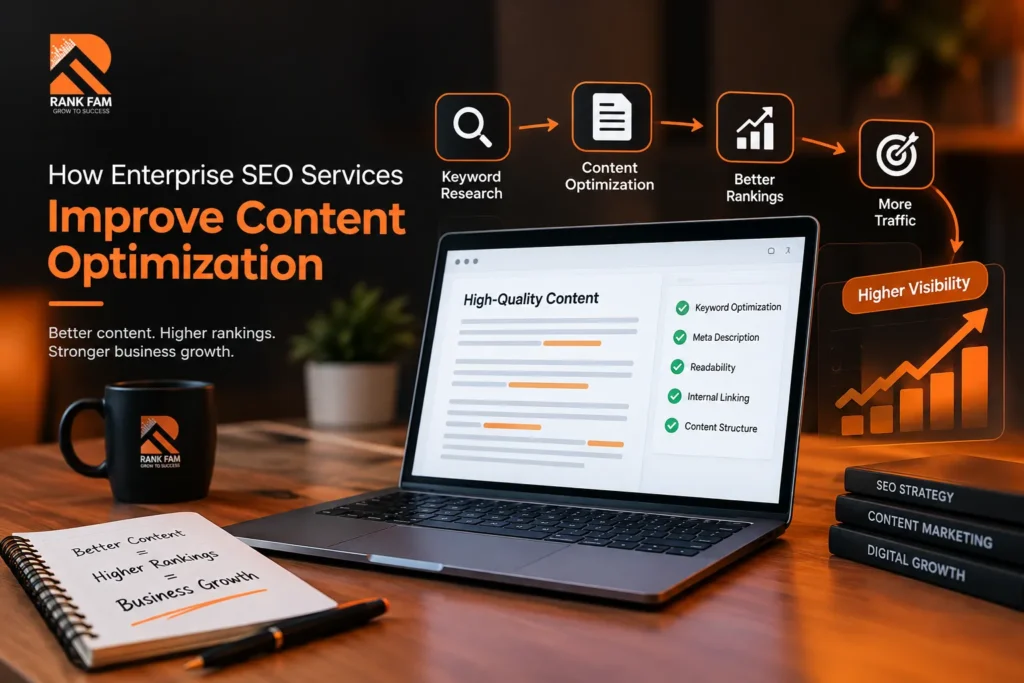
Content optimization means making each page clear, useful and easy for search engines to understand. On a large site, several things get in the way. Different teams use different styles. Old pages stay live for years. Templates repeat the same text across hundreds of pages. Have you ever searched your own company name and found an outdated page ranking above the new one? That’s a common sign of content drift.
The Backlinko click-through rate study found that the first Google result earns roughly a quarter to a third of all clicks. The gap between first and fifth place is huge. Enterprise SEO services help your best page win that top spot instead of letting five weak pages split the vote.
Start With a Full Content Audit
Every project begins with a close look at what you already have. We crawl the whole site and pull data from Google Search Console and analytics tools. The audit sorts every page into one of four groups: keep, improve, merge or remove.
This step often surprises owners. We have seen sites where a third of the pages got almost no visits and sat there only to waste crawl time. Enterprise SEO services cut that dead weight so search engines spend more time on pages that matter. A clean content base is the first win.
Fixing Keyword Cannibalization
Keyword cannibalization happens when two or more pages on your site compete for the same search. Google isn’t sure which one to show, so it often ranks neither well. This problem grows fast on large sites, since many writers publish on similar topics.
Here’s a simple example. A travel company had six blog posts about “best time to visit Spain.” Each had a little traffic, but none ranked on page one. We merged them into one strong guide and redirected the old links. Within a few months, the new page reached the first page. That kind of cleanup is a core part of enterprise SEO services.
Templates, Metadata and Duplicate Content
Large sites run on templates. A single template change can fix or break thousands of pages at once. Enterprise SEO services build rules for titles, meta descriptions, headings and image text so every page follows a clear pattern. For example, a product page title might follow the format “Product name, key feature | Brand.”
Google’s Search Central guides explain how duplicate content and canonical tags work. A canonical tag tells search engines which version of a page is the main one. We set these up across filters, sorting options and tracking links, which often create thousands of near-copies without anyone noticing.
How the Work Compares at Different Sizes
The table below shows how common content problems change as a site grows, and how enterprise SEO services respond.
| Problem | Small site | Large site | How we handle it |
| Missing titles | A few pages | Thousands of pages | Template rules and bulk updates |
| Duplicate pages | Rare | Common from filters and tags | Canonical tags and cleanup |
| Competing pages | One or two | Dozens per topic | Merge, redirect and map one page per topic |
| Outdated content | Easy to spot | Hidden for years | Audit and refresh schedule |
| Team workflow | One person | Many teams | Shared guidelines and checklists |
| Reporting | Simple | Needs segments by section | Dashboards by page type and market |
If you recognize two or three rows, your site likely needs this kind of help.
Content Gap Analysis and Topic Planning
Once the cleanup is done, we look forward. A content gap analysis compares your site with the top competitors in your market and lists the topics they cover that you don’t. It also shows which questions your customers ask that nobody answers well.
During content gap analysis, we group topics into clusters. A cluster has one main page and several supporting pages that link to each other. This helps search engines see your site as a trusted source on that subject. Enterprise SEO services turn this plan into a calendar so writers know what to create and in what order.
Quality, Trust and Helpful Content
Google’s Search Quality Rater Guidelines talk about experience, expertise, authority and trust, often shortened to E-E-A-T. Large sites sometimes lose trust when many pages look thin, copied or written without a real person behind them. Enterprise SEO services help by adding author names, clear sources, updated dates and real examples.
We tell our clients to ask one question about every page: would a real person find this helpful? If the answer is no, improve the page or remove it.
Internal Linking at Scale
Internal links pass strength from page to page and help visitors move through your site. On a big site, these links often grow by accident. Enterprise SEO services map your links so your most important pages get the most support. We use simple rules, like linking each new article to its topic hub and adding links from older high-traffic pages to newer ones.
BrightEdge research has shown that organic search drives more than half of trackable traffic for many large sites. That makes strong internal links one of the cheapest ways to protect a major traffic source.
Teamwork, Reporting and Results
The best plan fails if teams ignore it. So we create a short style guide, a content brief template and a review checklist. Writers, editors and developers all use the same rules. Enterprise SEO services also set up reports by page type, country and product line, so leaders can see what is working.
Results take time. Most large sites see early gains in two to three months, with bigger wins after six to twelve months. Be careful with anyone who promises overnight jumps on a site this size.
Conclusion
Enterprise SEO services bring order to large websites. They clean up old content, fix duplicate pages, set clear rules for templates and plan new topics based on real gaps. The result is a site where every page has a job and search engines can understand it. If you run a large site in Area, we at Rank Fam are glad to review your content and show you where to start. Steady, well-planned work beats quick fixes every time.
Frequently Asked Questions
What makes enterprise SEO different from regular SEO?
The main difference is size and teamwork. Enterprise sites have thousands or millions of pages, many writers and several developers. Fixes must work across templates and need approval from different teams. The work leans more on process, data and clear rules than on single page edits.
How long does it take to see results from enterprise SEO?
Most large sites see early movement within two to three months. Bigger gains often show after six to twelve months, since search engines need time to crawl and review so many pages. Content cleanup, redirects and template changes each add to the total. A good partner shares a clear timeline up front.
Can enterprise SEO help with duplicate content?
Yes, and it is one of the most common fixes on big sites. We find pages that repeat the same text, then merge them, redirect them or mark one as the main version with a canonical tag. This stops pages from competing with each other. It also helps search engines spend crawl time on your best pages.
How much do enterprise SEO services cost?
Price depends on your site size, the number of markets and how much hands-on work you need. Large sites usually pay a monthly fee that covers audits, planning, reporting and team support. Ask for a written scope that lists what you get each month. Very low prices often mean thin work that misses the deeper issues.
Who should handle content updates on a large site?
Ideally, a mix of writers, editors and developers who follow one shared guide. The SEO team sets the rules and checks the results, while each department owns its own pages. A simple checklist and a monthly review keep everyone on the same track. This avoids repeated mistakes and keeps quality steady.