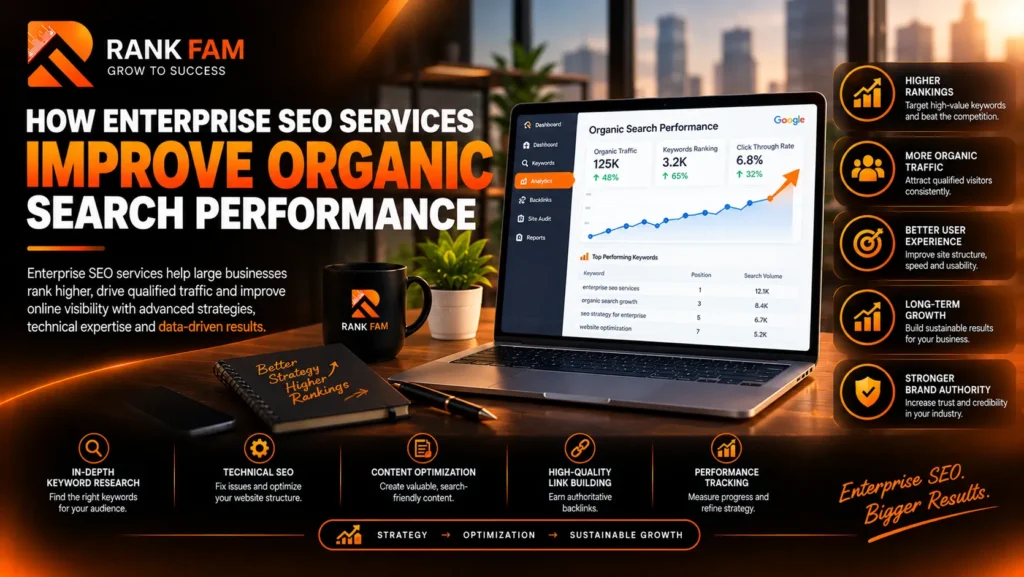
Large websites break in ways small sites never do. A store with 50,000 product pages, a software firm with ten regional teams, or a publisher with ten years of archives all face the same problem: search engines struggle to read them. That is the job of Enterprise SEO Services. They give big sites a clear plan, so Google can find the right pages and people can land on them.
At Rank Fam, a digital marketing agency in Billings, Montana, we help large teams turn messy sites into steady organic traffic. In this guide, we explain what enterprise SEO services cover, how they improve organic search performance, and what to look for before you hire a team. Sounds useful? Let’s get into it.
What Do Enterprise SEO Services Cover?
Enterprise SEO services are search programs built for large sites, many teams, and complex tech. A normal SEO plan might fix titles on 40 pages. Enterprise SEO handles thousands of pages, several languages, and a long list of people who all touch the site. We split the work into four parts: technical SEO, content, links, and reporting. Each part needs a clear owner, or things slip.
Scale changes everything. One small mistake in a page template can copy itself across 20,000 URLs. A single wrong tag can hide a whole product line from Google. So enterprise SEO is as much about process as it is about keywords.
Why Organic Search Still Deserves a Big Budget
Is organic search worth the effort when ads bring instant traffic? The numbers say yes. BrightEdge found that organic search drove 53% of all site traffic in its channel study, ahead of paid search at about 15%. Click data points the same way. Backlinko found that the first Google result earns an average click rate of 27.6%, and moving up one spot raises the click rate by roughly 32.3%. Organic search responsible for 53% of all site traffic, paid 15% [Study] +2
For a big site, one step up on a high-value term can mean thousands of extra visits each month. That is why good enterprise SEO services focus on pages that earn money, not pages that just look busy.
Fix the Technical Base First
Search engines can’t rank pages they can’t crawl. On large sites, wasted crawling is common, and Google’s own guidance says crawl budget matters mostly for very large sites. So every enterprise SEO services plan we write starts with a crawl audit. We look for:
- Duplicate pages created by filters and sorting
- Broken redirects and long redirect chains
- Thin or empty pages that waste crawl time
- Slow templates that fail Core Web Vitals, Google’s page speed checks
- Missing schema markup (extra code that explains a page to search engines) on products, articles, and FAQs
Here is a common case. An online store adds color and size filters, and each filter makes a new URL. Soon Google sees 200,000 near-copies of 5,000 products. Canonical tags, smart internal links, and clean sitemaps point Google back to the pages that matter. Our SEO Services team repeats this review after every big site release, since new code can bring old problems back.
Scale Content Without Losing Quality
Big sites often have two content problems at once: too much weak content, and too little strong content on the topics buyers search for. Enterprise SEO services deal with both. First, we prune. We merge, redirect, or rewrite old pages that get no traffic. Next, we run a content gap analysis for the large website, which shows the topics rivals cover and you don’t.
Then we build topic clusters. Each main topic gets a hub page, with supporting articles around it. Search engines read this setup as depth on a subject. We also match every page to search intent. Does the reader want to learn, compare, or buy? A guide shouldn’t fight a product page for the same term.
Good enterprise SEO services treat content like a product, not a pile of posts. We add named authors, real examples, and clear sources, since Google rewards pages that show real knowledge and trust.
Small Site SEO vs. Enterprise SEO Services
This table shows how the work changes as a site grows.
| Area | Small site SEO | Enterprise SEO services |
| Page count | Under 500 pages | Thousands to millions of pages |
| Main risk | Weak content | Wasted crawling and template errors |
| Team size | One or two people | Developers, writers, product, and legal teams |
| Fix method | Manual edits | Template rules and bulk updates |
| Reporting | Rankings and traffic | Revenue, share of voice, and page group trends |
Notice the shift from one-off edits to rules that apply everywhere. That shift is why enterprise SEO takes planning, not just effort.
Get Every Team Working Together
Most enterprise SEO problems are people problems. A developer ships a redesign on Friday. The SEO team hears about it Monday. Rankings drop Tuesday. Have you seen this happen at your company?
Strong enterprise SEO services stop this with simple habits. We set up an SEO checklist before every launch, share playbooks with writers and developers, and name one owner for site moves. A shared tracker keeps every team looking at the same list. Who signs off on a URL change in your company? If the answer is unclear, that is the first gap to close.
For brands selling in the United Kingdom, the United States, Canada, Australia, New Zealand, Ireland, and South Africa, one more habit matters. Use hreflang tags, which tell Google which page fits which country, and match local spelling such as “colour” and “color.” These small steps keep each market’s page in front of the right reader.
How to Measure Organic Search Performance
Track numbers that link to money. Google Search Console shows clicks, impressions, and search terms. GA4 shows what visitors do next. Group pages by type, such as product, blog, and location, so patterns show up fast.
Good enterprise SEO services report on non-brand organic clicks, rankings for priority terms, conversions from organic visits, and share of voice against rivals. Technical fixes often show results within one to three months. Content gains usually take six to twelve months, so patience helps.
Mistakes That Slow Results
Many competitor guides stop at definitions. These are the gaps we see most often:
- Chasing rankings and ignoring revenue
- Skipping SEO checks during redesigns and site moves
- Using one keyword list for every country
- Treating SEO as a one-time project instead of steady work
Avoid these four, and your enterprise SEO services will pay back faster.
Conclusion
Enterprise SEO services give large websites a clear path to better organic search performance. They fix the technical base, build content that matches search intent, and keep every team on the same plan. The research is clear: top positions earn the most clicks, and organic search brings the biggest share of traffic. Whether your team sits in Billings, Montana or across the globe, the steps stay the same. Start with a crawl audit, fix what blocks Google, and track results by revenue. We are ready to help whenever you want a second pair of eyes on your site.
Frequently Asked Questions
What makes enterprise SEO different from regular SEO?
The main difference is scale. Large sites have thousands of pages, many teams, and complex code, so one mistake can spread fast. The work leans on process, bulk fixes, and clear ownership rather than page-by-page edits.
How long does it take to see results?
Technical fixes can show gains in one to three months. Content and link work usually takes six to twelve months to build up. The timeline depends on your site size, your market, and how fast your teams can ship changes.
How much does it cost?
Price depends on site size, the number of countries, and how much content and technical work you need. A fair agency will audit your site first and then give a quote that matches the scope. Be careful with anyone who offers a flat price before looking at your site.
Do we still need an in-house team if we hire an agency?
Yes, in most cases. Your developers, writers, and product owners know your business best. The agency sets the plan, finds the problems, and guides your team, while your people make the changes on the site.
Which tools do large sites use for SEO?
Most teams use Google Search Console and GA4 for data. A site crawler finds broken pages and duplicates, and a rank tracker watches key terms. Some teams add server log tools to see how Google crawls the site.