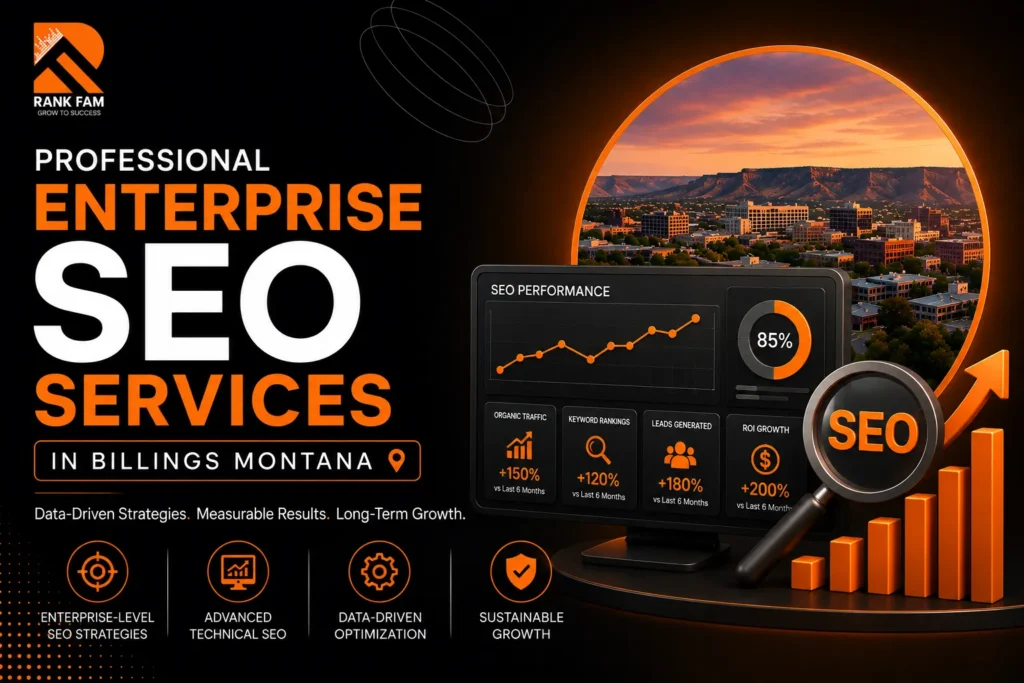
Have you ever wondered why a large organization with hundreds of web pages sometimes ranks worse than a much smaller competitor with a fraction of the content? Size alone does not win in search results. Structure, strategy, and consistent execution do. Rank Fam works with larger Billings-based organizations to bring order to complex websites and turn that scale into a real search advantage. In this guide, we’ll look at what sets enterprise SEO apart from smaller campaigns, why it matters for bigger organizations in Billings, and what to expect from a well-run program.
What Makes Enterprise SEO Different
Enterprise SEO is not simply small business SEO with a bigger budget. It involves managing thousands of pages, coordinating across departments, and connecting search performance directly to revenue reporting. A typical small business site might have twenty or thirty pages to optimize. An enterprise site can have tens of thousands, spread across product lines, regional pages, and support content, each needing its own attention.
This scale changes everything about how the work gets done. A single technical issue, like a slow-loading template used across ten thousand pages, can quietly cost far more traffic than any one blog post ever could. Enterprise SEO services focus on catching these large-scale problems early, since fixing them later, after they have already dragged down rankings, takes much longer.
Why the Returns Can Be So Strong
The financial case for enterprise SEO services is hard to ignore once you look at the numbers. First Page Sage’s 2026 analysis found that SEO delivers an average return of 748% across industries over a three-year period, with certain sectors like real estate and B2B software climbing even higher. For organizations already generating meaningful revenue online, that kind of return compounds quickly as rankings strengthen.
A separate 2026 industry report found that 78% of enterprises achieve at least 400% ROI from their SEO initiatives within twelve months. That is a striking figure for any marketing channel, and it explains why larger organizations increasingly treat SEO as a long-term investment rather than a short campaign to test and abandon.
Core Components of an Enterprise SEO Program
A strong program touches several moving parts at once, all working together rather than in isolation. Here is a breakdown of what typically falls under enterprise SEO services.
| Component | What It Covers | Why It Matters at Scale |
| Technical audits | Site speed, crawl efficiency, structure | Small fixes affect thousands of pages at once |
| Content strategy | Topic clusters, keyword mapping | Keeps large content libraries organized and relevant |
| Cross-team coordination | Working with engineering, product, marketing | Prevents conflicting priorities from slowing progress |
| Performance reporting | Tying organic traffic to revenue | Justifies continued investment to leadership |
| International or regional SEO | Managing multiple locations or markets | Avoids duplicate content and confusing search signals |
Organizations in Billings expanding into new regions or managing multiple service areas often find this last piece especially valuable, since regional pages need careful handling to avoid competing against each other in search results.
How Enterprise SEO Services Handle Complexity
So how does a specialist actually manage a site with ten thousand or more pages without losing track of priorities? The answer usually comes down to prioritization based on impact. Rather than treating every page equally, enterprise SEO services typically start with the pages already receiving meaningful traffic, since even a small improvement there tends to produce a bigger overall lift than starting from scratch on brand-new content.
Research on large-scale sites backs this approach. At sites with 100,000 or more pages, even a half-percent improvement in crawl efficiency or internal linking can drive millions of additional organic visits over a year. That kind of leverage simply does not exist at smaller scales, which is part of why enterprise SEO services require a different mindset from standard small business work.
Timeline and Realistic Expectations
Patience matters here more than almost anywhere else in marketing. Most enterprise SEO programs begin showing measurable improvement in rankings and traffic within three to six months, though meaningful revenue impact usually takes six to twelve months to become clear. This is not a slow process by accident. Large sites take longer for search engines to fully crawl, reassess, and trust after major changes.
I once sat in on a planning meeting for a regional company expanding across several states, where the marketing lead admitted she expected results within a month. Once we walked through the sheer number of pages involved and the technical cleanup needed first, she understood why the timeline stretched closer to half a year before real movement showed up. Setting that expectation early prevented a lot of frustration down the road.
Signs Your Organization Needs Enterprise SEO Services
A few patterns suggest it is time to bring in dedicated support. Your organic traffic has plateaued despite adding new content regularly, which often points to technical or structural issues rather than a content gap. Different departments are creating overlapping or competing pages without any shared keyword strategy, confusing both users and search engines. Your website has grown faster than your ability to maintain it, leaving broken links, outdated pages, and inconsistent formatting scattered throughout.
If any of these sound familiar, a focused enterprise SEO services engagement can often untangle the mess faster than trying to fix it piece by piece internally, especially when specialized technical expertise is limited in-house.
Conclusion
Enterprise SEO services give larger Billings organizations a structured way to turn a large, complex website into a genuine growth engine rather than a liability. The data consistently shows strong long-term returns, but only when technical foundations, content strategy, and cross-team coordination work together rather than in isolation. Patience pays off here, since meaningful results typically build over several months rather than weeks. For organizations managing thousands of pages and multiple stakeholders, a dedicated, experienced approach tends to outperform scattered, piecemeal fixes by a wide margin.
FAQs
How is enterprise SEO different from regular SEO services?
Enterprise SEO deals with much larger websites, often ten thousand pages or more, along with multiple departments, regional markets, and complex approval processes. Standard SEO usually applies to smaller sites with simpler structures and fewer stakeholders involved in decisions. The core principles overlap, but the scale and coordination required at the enterprise level demand a different approach entirely.
How long does it take to see measurable results?
Most organizations see initial ranking and traffic improvements within three to six months, with clearer revenue impact typically appearing between six and twelve months. Larger sites take longer for search engines to fully re-crawl and reassess after significant changes. Full payback on the investment often plays out over eighteen months or longer, though the returns tend to keep compounding well beyond that point.
What size company actually needs enterprise SEO services?
Generally, organizations managing thousands of web pages, multiple departments, or several regional or international markets benefit most from this level of service. Smaller businesses with a few dozen pages usually see better results from standard SEO packages built for their scale. The right fit depends less on company size in employees and more on website complexity and page count.
Can enterprise SEO work alongside an in-house marketing team?
Yes, and this is actually the most common setup. External specialists often bring technical expertise and bandwidth that in-house teams lack the time to build internally, while in-house staff provide context on business priorities and brand voice. Clear communication between both groups tends to produce the strongest results.
What is the biggest technical challenge for large websites?
Crawl efficiency tends to be one of the biggest hurdles, since search engines cannot index every page instantly on very large sites, especially with frequent updates or product changes. Poor internal linking and duplicate content across regional or product pages also cause significant issues at scale. Addressing these technical foundations first usually unlocks better performance from every other part of the strategy.