Ever wonder why a company with thousands of employees still spends serious money on search rankings? You’d think a big name alone would be enough to show up on page one. It isn’t. Large websites face a different kind of challenge than small ones, and that’s exactly the gap enterprise SEO services are built to close.
At Rank Fam, we work with large organizations that have hundreds or even thousands of pages, multiple teams touching content, and competitors just as big as they are. Enterprise SEO services exist because managing search visibility at that scale takes a different approach than what works for a small business site. Let’s look at why big companies invest so heavily in this work and what actually goes into it.
Why Small-Scale SEO Doesn’t Work for Large Sites
A small business might have twenty pages and one person managing content. A large enterprise can have tens of thousands of pages, several departments publishing content independently, and websites spread across different countries and languages. That size creates problems a small site never has to deal with.
Duplicate content can appear across regional pages without anyone noticing. Old pages pile up and compete with newer ones for the same keywords. Technical issues on one part of a massive site can quietly affect rankings across the whole domain. This is exactly why enterprise SEO services focus on systems and processes, not just individual page tweaks.
What Enterprise SEO Services Actually Involve
The work looks different once a website reaches enterprise size. Here’s what typically gets covered.
1. Technical SEO at scale. Large sites need regular audits to catch crawl errors, broken links, and indexing issues across thousands of pages, since manual checks aren’t realistic at that volume.
2. Content governance. With multiple teams publishing content, enterprise SEO services often include guidelines and workflows so pages don’t compete against each other for the same keywords.
3. International and multi-location SEO. Companies operating in several countries need proper site structure, language targeting, and local search optimization for each region they serve.
4. Site architecture planning. How pages link to each other matters even more on a large site, since poor structure can bury valuable content under layers of navigation.
5. Ongoing reporting across departments. Enterprise SEO services usually involve reporting that different teams, marketing, IT, and leadership, can all understand and act on.
A report from BrightEdge found that organic search drives a large share of trackable website traffic for most industries, often outperforming paid search and social combined.Organic search consistently accounts for a significant portion of overall website traffic across industries, which makes ranking visibility a direct factor in revenue for large companies with high-traffic sites. That scale of impact is exactly why enterprise SEO services carry a bigger budget than smaller campaigns.
Comparing Small Business SEO to Enterprise SEO
It helps to see the differences side by side.
| Factor | Small Business SEO | Enterprise SEO Services |
| Page count | Dozens | Thousands or more |
| Teams involved | Usually one person | Multiple departments |
| Content control | Centralized | Needs governance systems |
| Technical audits | Occasional | Ongoing, automated tools needed |
| International reach | Rare | Common, multi-language sites |
| Reporting needs | Simple | Cross-department, detailed |
As the table shows, the jump in complexity isn’t small. A strategy built for a twenty-page site simply breaks down once a company is managing content across dozens of departments and regions.
Why Competition Plays a Bigger Role
Large businesses usually compete against other large businesses, and that competition raises the stakes. If a company skips proper enterprise SEO services, a competitor with a tighter strategy can quietly take over search rankings for terms that drive real revenue. This isn’t a slow process either. Search rankings shift constantly, and a site that falls behind on technical health or content quality can lose ground within weeks.
Our team at Rank Fam has seen how quickly a large site can lose visibility when technical issues go unnoticed for even a short period. A single misconfigured redirect across a large site can quietly drop rankings on hundreds of pages before anyone catches it. That’s the kind of risk enterprise SEO services are designed to catch early.
A study from Moz found that page load speed and crawl efficiency have a measurable effect on how search engines rank large websites, especially those with heavy page counts and complex navigation.Sites with slower load times and inefficient crawling patterns tend to see reduced indexing frequency, which can delay how quickly new or updated pages appear in search results. For an enterprise site publishing content constantly, that delay can cost real traffic.
What to Look for in an Enterprise SEO Partner
Not every SEO provider is equipped to handle enterprise-level work. Before hiring anyone, ask a few direct questions.
Have they worked with sites of a similar size and complexity before? Can they handle technical audits across thousands of pages without missing critical issues? Do they have experience with international SEO if your company operates in multiple regions? And can they create reporting that works for both technical teams and leadership?
These questions matter because enterprise SEO services require tools, processes, and experience that a small agency built for local businesses often doesn’t have.
Conclusion
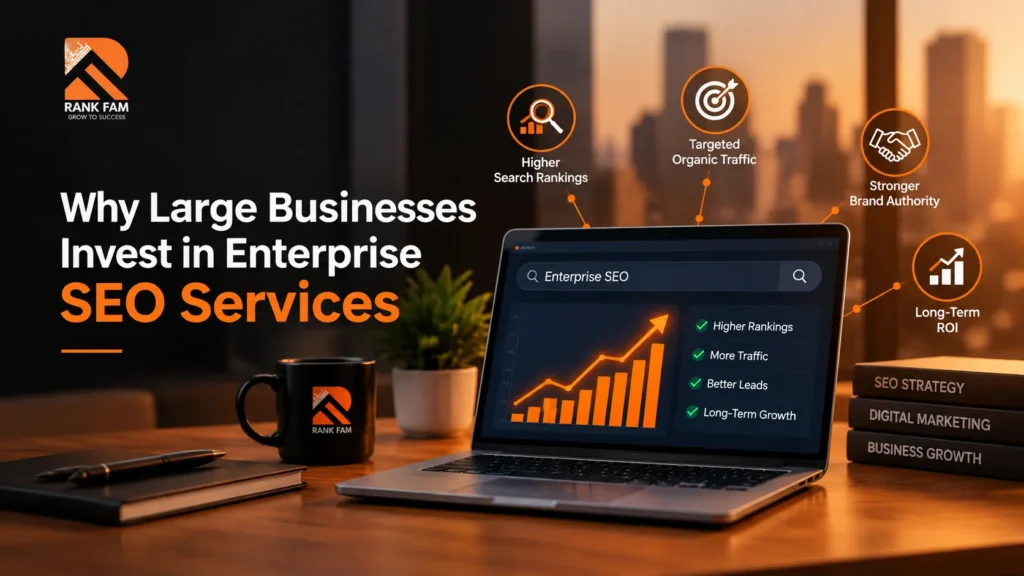
Large businesses invest in enterprise SEO services because the scale, complexity, and competition they face require more than basic keyword optimization. Managing technical health, content governance, and international structure across thousands of pages takes systems that smaller sites simply don’t need. Getting this work right protects revenue that depends directly on organic search visibility. Rank Fam builds these systems around each company’s specific structure, because at enterprise scale, small oversights can turn into large losses if they go unnoticed for too long.
Frequently Asked Questions
How is enterprise SEO different from regular SEO?
Enterprise SEO deals with much larger websites, often involving thousands of pages, multiple departments, and sometimes several countries or languages. Regular SEO usually focuses on a smaller set of pages managed by one team. The tools, processes, and reporting needed for enterprise-level work are built for that added complexity.
How much do enterprise SEO services typically cost?
Costs vary widely based on site size, number of markets served, and how much technical work is needed upfront. Most enterprise campaigns involve a higher monthly investment than small business SEO due to the scale of ongoing work. Getting a detailed proposal based on your specific site helps set realistic budget expectations.
Why do large companies need content governance for SEO?
When multiple teams publish content independently, pages can end up competing against each other for the same keywords without anyone noticing. Content governance creates guidelines so departments coordinate instead of working against each other. This keeps a company’s own pages from canceling out each other’s rankings.
Can enterprise SEO services help with international search rankings?
Yes, this is often a major part of the work for companies operating in multiple countries or languages. Proper site structure, language targeting, and regional optimization all play a role in ranking well across different markets. Without this setup, international pages can struggle to gain visibility in local search results.
How often should a large website get a technical SEO audit?
Most enterprise sites benefit from ongoing monitoring rather than occasional checks, since issues can appear quickly across thousands of pages. Many companies schedule detailed audits quarterly, with automated tools flagging urgent problems in between. Waiting too long between audits can let small technical issues turn into larger ranking losses.